
Millions of honey bees escape after semi-truck overturns in Whatcom County







WHATCOM COUNTY, Wash. — CORRECTION: The Whatcom County Sheriff's Office now says 250 million bees did not escape, but 14 million. The correction was posted on the sheriff's office Facebook page Saturday morning.
A buzz-worthy story is unfolding in Whatcom County, where 14 million bees escaped after a commercial truck carrying about 70,000 pounds of honey bee hives lost part of its load early Friday.
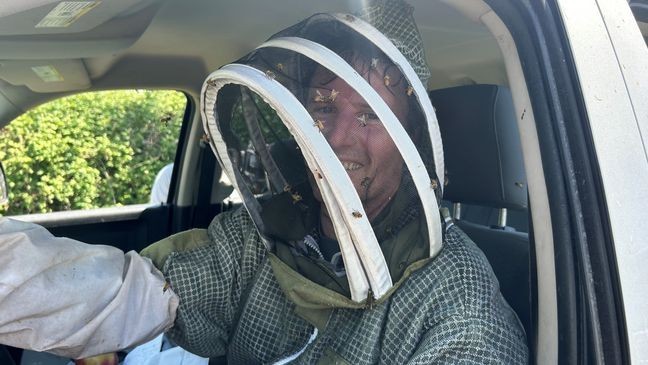
“When I came back from the front, this little beekeeping suit that they gave, I was just pretty much covered in bees and I didn’t even go right up to the truck,” Matt Klein, deputy director for Whatcom County Sheriff’s Office Emergency Management, told KOMO News.
The sheriff's office said deputies, Whatcom County Public Works and “several bee experts” responded to the scene on Weidkamp Road. The sheriff's office said the truck overturned around 4 a.m. in a rural area northwest of Lynden near the Canadian border.
Weidkamp Road is closed between Loomis Trail Road and West Badger. Klein told KOMO that Weidkamp Road is expected to be closed until Saturday morning.
People were cautioned to avoid the area and stay back at least 200 yards. The sheriff’s office said the hives came off the truck shortly after 9 a.m. Friday, which freed millions of bees.
Derek Condit, who coincidentally just published a book, "The Natural Beekeeper's Path: Treatment-Free Practices for a Living World," heard about the situation, grabbed his beekeeping suit, and headed to the crash scene to help. He was just one of more than a dozen beekeepers who came from Whatcom and Snohomish counties.
When the truck rolled over, Condit explained how that left hundreds of hives, crushed or leaning on each other.
“So, it’s not necessarily something we can go up with the keepers and just grab the beehives that are collapsing and falling apart, so we’re basically one by one rebuilding the beehives, putting the frames back in and have to stack them,” Condit said.
So once the hives are rebuilt and stacked, will the bees return to them?
“It’s a percentage thing, and in this case, no, the bees... there’s going to be massive losses,” Condit answered.
Another beekeeper, Russell Deputch, had a small smoke machine designed to calm the bees.
“With the smoke, sometimes it works, but when they’re really angry like this, it doesn’t really work too well,” Deputch said.
“A number of the beekeepers, they’ve gotten stung as well as a couple of our deputies,” Klein said.
Our KOMO News crew was also stung, even though they were about 300 yards away from the hives and swarms of bees.
“But they’re honeybees, so the sting isn’t as severe as some other bees, so, so far, everybody is fine,” Klein said.
The master beekeepers working on the hives had done all they could by about 2 p.m. Friday.
“These bees are going to swarm in the local areas and start new hives, luckily, so there will be re-pollination in this area, but there will be great losses as well,” Condit said.
"We’re very mindful of the fact that bees are an endangered portion of our population here, and we wanna make sure we’re doing our best. Take care of our farmer community," Klein said.
"There’s only so many hives, and bees are already having extreme losses worldwide. It’s a big deal," Condit added.
Photos from the scene show the truck's trailer twisted across the road, dozens of hives askew across the trailer, and millions of insects rising in a smoky-looking swarm.
Authorities said while there is no general health risk to the public, deputies at the scene have been stung. Anyone with a bee sting allergy or who wants more information can check the protection guidance page on the health department's website.
The scene was turned over to the WCSO Division of Emergency Management Friday morning.
So, why were there so many bees on one truck?
“This happens regularly every year," Klein said. "We get the pollinators up, so you know we can have our raspberries and strawberries and all the different crops we grow, and Whatcom County to get those pollinators up here."
KOMO News asked Klein if bees were a part of emergency management training.
“Well, you know we joke around in Emergency Management that if it’s something weird and it doesn’t look good, who are you gonna call, right? We’re not quite Ghostbusters, but,” he answered.
Klein told KOMO News that this is what he loves about his job. It's always something new.
"Seems like this will help test our response plans now. Obviously, we don’t have a bee response plan, but it might go in the book now," Klein said.
ALSO SEE | I-5 abuzz with millions of bees after semi truck tips over
The incident is not the first in which millions of bees escaped when a semi-truck carrying numerous hives crashed.
In 2015, 14 million bees escaped when a semi-truck carrying millions of bees overturned on Interstate 5.
